Predictive Maintenance 2.0: Connecting RAG to SCADA Systems for Zero Downtime Manufacturing
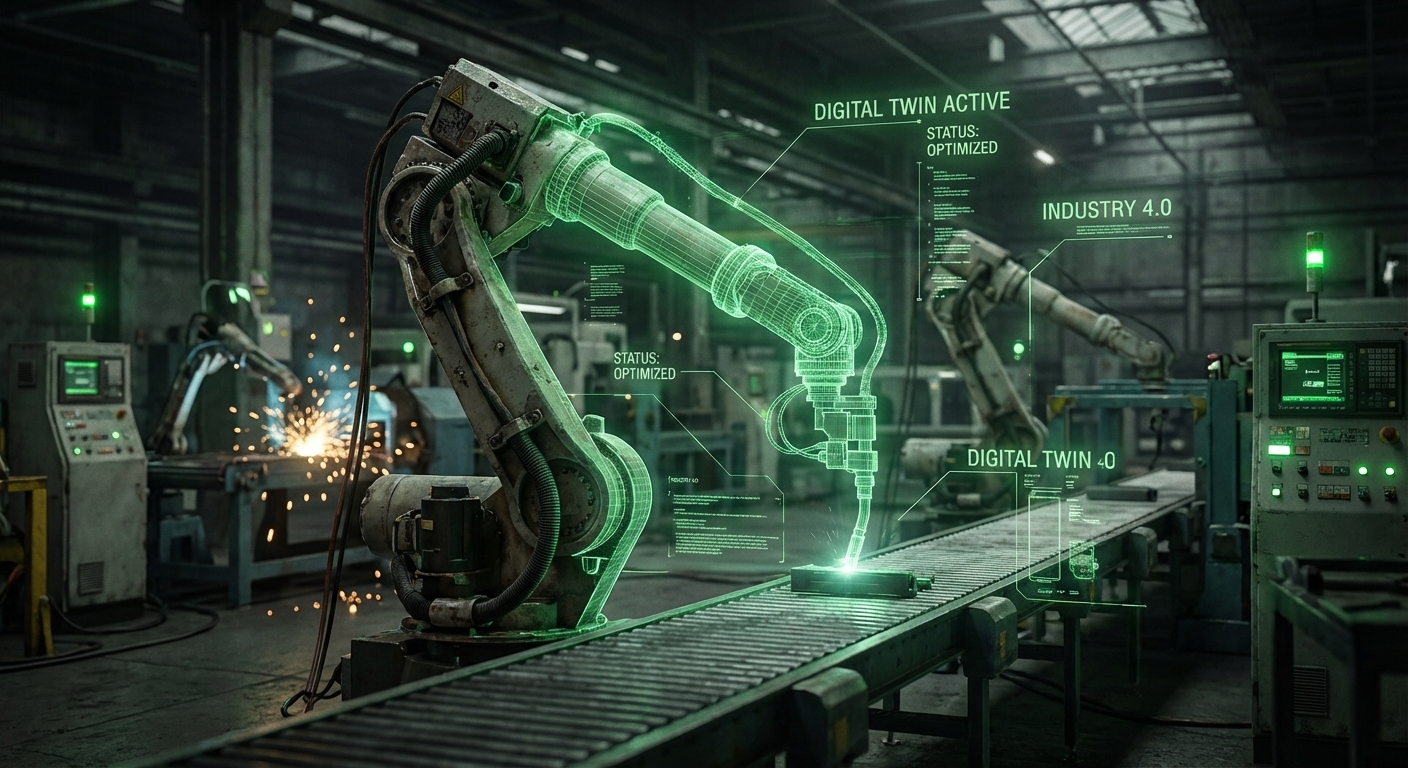
- Unplanned downtime costs Fortune Global 500 companies $1.4 trillion annually, with automotive plants losing $2.3 million per hour
- RAG-enhanced predictive maintenance systems deliver 25 to 50% reductions in unplanned downtime by combining sensor data with institutional knowledge
- The Model Context Protocol (MCP) enables modular integration of diverse industrial data sources through standardized connectors
- Brownfield implementations layer AI capabilities over existing SCADA infrastructure without replacing core control systems
- Most predictive maintenance AI qualifies as minimal risk under EU AI Act, with safety-critical
Manufacturing’s $1.4 trillion annual downtime problem has a new solution. Retrieval-Augmented Generation (RAG) systems connected to SCADA infrastructure via standardized protocols like MCP are transforming predictive maintenance from statistical forecasting into prescriptive, context-aware decision support. Early adopters report 25 to 50% reductions in unplanned downtime and ROI within months, not years. This represents a fundamental shift: AI systems that don’t just predict failures but understand why equipment fails and how to fix it. These systems synthesize real-time sensor data with decades of maintenance knowledge buried in manuals, schematics, and historical repair logs.
The $260,000-Per-Hour Problem SCADA Alone Cannot Solve
Fortune Global 500 companies now lose $1.4 trillion annually to unplanned downtime. This represents 11% of revenues and a 62% increase from 2019-2020, according to Siemens’ 2024 “True Cost of Downtime” report. Automotive plants hemorrhage $2.3 million per hour when lines stop, while oil and gas facilities face costs exceeding $500,000 hourly. The ABB Value of Reliability Report found two-thirds of companies experience monthly unplanned downtime events averaging four hours each.
Traditional SCADA systems, despite decades of refinement, hit fundamental architectural limitations when addressing these costs. Rule-based threshold alerts trigger only when parameters exceed static limits. This approach misses the gradual degradation patterns that precede 70% of equipment failures. Siloed data architectures create “islands of automation” where operations teams access real-time process data but maintenance teams lack context. Perhaps most critically, SCADA excels at detecting that something is wrong but struggles with diagnosing root causes and guiding resolution.
The maintenance paradigm has evolved through four generations: reactive (run-to-failure), preventive (calendar-based), predictive (condition-based), and now prescriptive (AI-recommended actions). MIT research on multimodal generative AI for maintenance documents the value at stake. Predictive maintenance delivers 10 to 40% maintenance cost reduction, 50 to 70% downtime reduction, and 10:1 to 30:1 ROI within 12 to 18 months. Yet only 26% of manufacturers have achieved fully data-driven predictive strategies, and just 30% of programs fully meet their objectives. The gap exists largely due to integration complexity and the inability to synthesize structured sensor data with unstructured institutional knowledge.
How RAG Transforms Maintenance from Prediction to Prescription
RAG architecture addresses the “phase two problem” by combining real-time anomaly detection with semantic retrieval from maintenance documentation, historical failure reports, and equipment specifications. When a vibration anomaly triggers on a pump bearing, a traditional ML system outputs a probability score. A RAG-enhanced system retrieves the relevant maintenance manual sections, similar past failure reports, required spare parts, and recommended repair procedures. It generates actionable guidance a technician can immediately use.
The technical architecture follows a three-layer pattern. The detection layer handles real-time sensor data acquisition and traditional ML anomaly detection, serializing time-series data for LLM processing. The RAG knowledge layer embeds maintenance manuals, P&ID diagrams, historical logs, and spare parts catalogs into vector databases using domain-specific embedding models. The generation layer augments prompts with retrieved context, applies safety guardrails, and integrates with maintenance management systems.
Siemens Industrial Copilot demonstrates this architecture in production. Deployed across 100+ companies in pilot programs, it translates machine error codes into troubleshooting guidance, generates PLC code from natural language, and extends the Senseye predictive maintenance platform with generative AI. Documented results include 25% reduction in reactive maintenance time, panel visualization creation in 30 seconds (versus manual hours), and generated code requiring only 20% adaptation. The academic PARAM framework (Prescriptive Agents based on RAG for Automated Maintenance) validates similar architectures for bearing anomaly detection with edge-deployable small language models.
Critical technical challenges distinguish industrial RAG from general-purpose implementations. Hallucination risks in safety-critical contexts demand grounded generation with source citations. Research shows even advanced models exhibit 33 to 79% hallucination rates on certain benchmarks. Domain vocabulary gaps require hybrid search combining semantic and keyword matching, since standard embedding models poorly handle equipment nomenclature like “PLC3_AI_008.” Real-time requirements drive edge deployment of smaller models for latency-sensitive decisions, with cloud inference reserved for complex reasoning.
Data Sources That Power Manufacturing RAG Systems
Effective industrial RAG requires integrating five primary data categories, each demanding specialized processing approaches.
Maintenance manuals and SOPs require structure-preserving chunking rather than arbitrary token windows. This approach preserves section hierarchy and page-level metadata for accurate retrieval.
Equipment schematics and P&IDs are best represented as knowledge graphs in Neo4j. This enables explicit relationship traversal from equipment nodes to connected sensors to relevant procedures.
Historical maintenance logs demand entity extraction and time-aware retrieval. This links similar failure patterns across equipment and time periods.
Spare parts catalogs require hybrid search combining exact part number matching with semantic similarity for specification lookups.
Sensor data streams need serialization techniques for LLM consumption, typically through summary statistics and anomaly context injection.
The IT/OT data bridge remains the critical integration challenge. Sensor tags lack contextual meaning for AI systems without standardized information models. OPC-UA companion specifications (EUROMAP 83, ISA-95, PackML) provide ready-made schemas that research shows reduce AI model training requirements by 40 to 60% through enriched contextual data.
Model Context Protocol Enables Modular Industrial RAG Architectures
The Model Context Protocol (MCP), introduced by Anthropic in November 2024 and transferred to the Linux Foundation’s Agentic AI Foundation in December 2025, provides the standardized connector layer industrial RAG requires. After one year, the ecosystem has grown to 5,800+ servers, 300+ clients, and 97 million monthly SDK downloads. The protocol has been adopted by OpenAI, Google DeepMind, Microsoft, and major enterprises including Bloomberg and Amazon.
MCP’s architecture transforms the M×N integration problem (every AI application connecting to every data source) into an M+N problem through three primitives. Tools are model-invoked functions like querying historians or reading sensor values. Resources are application-fetched context like equipment documentation. Prompts are user-initiated workflow templates. The protocol supports both local deployment via STDIO transport and cloud-scale remote deployments via Streamable HTTP with OAuth authentication.
For industrial integration, MCP servers act as standardized adapters to existing OT infrastructure. A conceptual architecture places MCP servers as connectors to OPC-UA endpoints, historians, and SCADA systems. Each server exposes domain-specific tools and resources while maintaining the secure data pipeline OPC-UA provides. ARC Advisory Group’s analysis emphasizes: “MCP complements OPC UA; it does not replace it. OPC UA secures the vital data pipeline from the OT layer… and MCP provides a standardized way for Industrial AI models to leverage this rich, contextualized information.”
MCP-Based Data Source Pre-Filtering
The power of MCP for manufacturing RAG lies in its ability to pre-filter and contextualize data before it reaches the LLM. Rather than overwhelming the model with all available information, MCP servers can expose focused tools for specific data domains:
| MCP Server | Data Domain | Pre-Filtering Logic |
|---|---|---|
| scada-mcp | Real-time sensor values | Returns only sensors associated with queried equipment, includes alarm status |
| historian-mcp | Time-series history | Filters by equipment ID, time range, and anomaly windows |
| manual-mcp | Maintenance documentation | Retrieves sections matching equipment type and fault code |
| parts-mcp | Spare parts catalog | Filters by equipment compatibility and availability status |
| logs-mcp | Historical maintenance records | Retrieves similar past failures by symptom pattern |
This architecture enables context-aware retrieval. When a technician asks “Why is Pump 7 vibrating?”, the orchestrating agent can call scada-mcp for current vibration readings, historian-mcp for trend data over the past week, manual-mcp for vibration troubleshooting procedures specific to that pump model, and logs-mcp for previous vibration incidents on similar equipment. Each MCP server pre-filters its domain, returning only relevant context rather than raw data dumps.
The RAG-MCP pattern also addresses tool proliferation at scale. Research demonstrates that embedding all tool definitions into a vector database, then retrieving only semantically relevant tools for each query, achieves 50%+ reduction in prompt tokens and 3x improvement in tool selection accuracy. This becomes critical when connecting hundreds of industrial data sources.
Brownfield Integration Preserves Existing SCADA Investments
Most manufacturers face brownfield reality: extending existing SCADA systems without replacement. The recommended approach layers AI capabilities non-invasively, keeping existing control loops intact while AI operates in advisory mode. OPC-UA gateways serve as the primary integration point, providing vendor-neutral access to legacy PLCs through a standardized semantic information model with built-in security.
The integration pattern flows as follows: Legacy PLCs and Sensors connect to an OPC-UA Gateway, which connects to an MQTT Broker, which feeds Edge Processing, which connects to Cloud Analytics. Data historians become ML data sources, providing decades of operational history for model training without modifying production systems. DMZ architecture ensures PLCs and SCADA never connect directly to internet-facing systems. This is a critical security requirement under IEC 62443 standards.
Apache Kafka has emerged as a modernization pattern for event-based SCADA extension, demonstrated in the 50Hertz case study where a central streaming platform supports hybrid edge-cloud deployment with CIM-compliant data schemas. Phased migration typically spans 12 to 18 months: assessment and infrastructure mapping (months 1-2), data foundation with OPC-UA gateways and edge-to-cloud flows (months 3-5), initial ML use cases in shadow mode (months 6-9), scaling and refinement (months 10-14), and optimization toward autonomous operations where appropriate (months 15-18).
Greenfield Deployments Enable Native AI Integration
Greenfield deployments leverage cloud-native platforms with native AI integration. Azure IoT Operations builds on Kubernetes with edge-native MQTT brokering, 72-hour offline operation capability, and automatic device discovery via Akri connectors. The platform’s OPC-UA connector provides standardized access to industrial assets. AWS IoT Greengrass provides edge runtime with local ML inference and offline operation. Both platforms support the hybrid architecture pattern where edge handles time-critical decisions under 100ms while cloud performs complex model training and batch analytics.
Verified Case Studies Demonstrate 30 to 50% Downtime Reduction
Documented implementations across major industrial vendors show consistent patterns.
Siemens Amberg Electronics Plant achieved 30% reduction in unplanned downtime, 15% increase in asset utilization, and 99.9% production quality using MindSphere with digital twins and edge AI. The plant has been recognized as a World Economic Forum Lighthouse Factory. The Senseye integration monitors 1.3 million devices across 41 Siemens facilities.
Schneider Electric’s Le Vaudreuil Factory, another Lighthouse site, implemented AVEVA Insight with Senseye PdM to achieve 7-point improvement in OEE and 20% reduction in maintenance costs on critical machines. Their Xiamen plant reports $1.2 million annual maintenance savings with Mean Time to Repair under 12 hours through EcoStruxure PMA monitoring vacuum furnaces.
GE Digital claims over 1.2 million digital twins created, generating approximately $600 billion in combined value for GE and customers, with individual implementations showing 40% reduction in unplanned downtime and 20% cut in maintenance costs. GE’s IIoT technology strategy enables predictive maintenance across diverse OEM equipment. Intel’s semiconductor fabrication facility used Predix APM to achieve “zero production loss” from fan filter unit failures that previously caused 3 to 4 days of unplanned downtime per incident.
BMW Group’s Regensburg plant deployed AI-supported predictive maintenance for conveyor technology producing up to 1,000 vehicles daily, avoiding approximately 500 minutes of assembly disruption annually through early fault identification.
ABB Ability Smart Sensors demonstrate up to 70% reduction in motor downtime and 30% extension of asset lifespan. This was validated at Tenaris steel manufacturing where 290 low-voltage motors and 20 high-voltage motors receive continuous condition monitoring for 24/7 production operations.
EU AI Act Classification Depends on Safety-Critical Function
The EU AI Act (Regulation 2024/1689) introduces compliance requirements that affect predictive maintenance systems based on their classification. Most standard implementations qualify as minimal or limited risk with minimal regulatory burden. This includes systems forecasting equipment wear, scheduling maintenance, and optimizing operations without direct safety control. Systems integrated as safety components in CE-marked machinery, or those controlling critical infrastructure, trigger high-risk classification under Annex I or Annex III.
High-risk classification imposes substantial requirements under Articles 9-15. These include continuous risk management systems throughout AI lifecycle, data governance measures ensuring training data is relevant, representative, and bias-examined, technical documentation per Annex IV specifications, automatic event logging retained for at least 10 years, transparency requirements for deployers to interpret outputs appropriately, and human oversight capabilities including override and intervention mechanisms.
Key compliance deadlines are August 2, 2026 for Annex III high-risk systems (sensitive use cases) and August 2, 2027 for Annex I systems (regulated products like machinery). The Commission will publish clarifying guidelines on Article 6 classification by February 2026. This is critical timing for manufacturers assessing their systems. Industry consultation confirms that predictive maintenance AI “should not fall under the definition of high-risk AI” when it operates alongside other safety measures without directly impacting critical infrastructure management.
Data sovereignty considerations affect cloud-based implementations. While no explicit EU data localization requirement exists, the US CLOUD Act’s extraterritorial reach and Schrems II implications drive some manufacturers toward sovereign EU infrastructure. The proposed EU Cloud and AI Development Act, expected March 2026, may add security and data localization requirements for critical workloads.
Architecture Patterns for Practical Implementation
The recommended edge-to-cloud architecture places time-series databases (InfluxDB, Amazon Timestream) at the foundation for high-frequency sensor data with efficient compression and time-range queries. Vector databases (Pinecone, Weaviate, Qdrant) power RAG retrieval over maintenance documentation. Edge ML inference using TensorFlow Lite or ONNX handles time-critical anomaly detection with millisecond latency, while cloud performs complex model training and batch analytics requiring complete historical datasets.
Human-in-the-loop patterns are non-negotiable for safety-critical decisions. The approval gate pattern requires human confirmation before AI-recommended actions execute for major process changes. Exception review escalates uncertain classifications to human experts. Continuous monitoring enables intervention during real-time optimization. Periodic audit verifies compliance through post-hoc review of AI decision batches.
The emerging industrial AI protocol stack layers OPC-UA for secure OT data acquisition, Unified Namespace (UNS) for data organization and contextualization, MCP for AI access to tools and context, and Agent-to-Agent protocols (A2A) for multi-agent coordination. This layered approach preserves investments in OPC-UA infrastructure while enabling modern AI capabilities without architectural disruption.
Conclusion
Predictive Maintenance 2.0 represents the convergence of two previously separate domains: operational intelligence from sensors and SCADA systems, and knowledge intelligence from documentation, procedures, and institutional expertise. RAG architecture bridges this gap, while MCP provides the standardized connectivity layer that makes integration practical rather than bespoke.
The business case is compelling: $1.4 trillion in annual downtime costs, validated 30 to 50% downtime reductions from early adopters, and ROI typically achieved within 3 to 18 months. The technical path is increasingly clear. Organizations should layer AI capabilities over existing OPC-UA infrastructure, embed institutional knowledge into vector databases, and deploy edge inference for time-critical decisions while leveraging cloud for complex reasoning.
The regulatory environment favors action. Most predictive maintenance implementations classify as minimal risk under EU AI Act, while those approaching safety-critical functions have until August 2027 for full compliance with high-risk requirements. Organizations beginning now have sufficient runway to build compliant systems while capturing competitive advantage from reduced downtime and maintenance costs.
The manufacturers achieving zero downtime are not replacing their SCADA systems. They are augmenting them with AI that understands not just what is failing, but why it is failing and how to fix it. That synthesis of real-time data with accumulated knowledge is what transforms predictive maintenance from statistical forecasting into prescriptive action.
How PrivaCorp Addresses These Challenges
PrivaCorp was architected specifically for industrial RAG deployments where data sovereignty and system integration complexity are primary concerns.
MCP-Native Architecture for Industrial Data Sources
The Challenge: Connecting RAG systems to diverse industrial data sources (SCADA, historians, documentation, parts catalogs) typically requires custom integration for each source. This creates maintenance burden and limits scalability.
PrivaCorp’s Approach: The platform’s MCP-native architecture treats each data source as a pluggable server. Pre-built connectors for OPC-UA endpoints, common historian platforms, and document repositories can be deployed alongside custom MCP servers for proprietary systems. The orchestration layer handles tool selection and context assembly automatically, reducing integration time from months to weeks.
For brownfield environments, PrivaCorp’s MCP servers can connect to existing OPC-UA gateways without modifying production infrastructure. Sensor data, equipment documentation, and maintenance history flow through standardized interfaces while remaining within customer-controlled infrastructure.
Complete Data Sovereignty for OT Environments
The Challenge: Manufacturing sensor data and maintenance knowledge represent critical intellectual property. Cloud-based AI solutions create data residency concerns and potential exposure of operational insights to third parties.
PrivaCorp’s Approach: The “Bring Your Own Vault” architecture ensures all data processing occurs within customer infrastructure. Vector embeddings of maintenance manuals, historical failure patterns, and equipment specifications never leave your environment. For air-gapped OT networks common in critical manufacturing, PrivaCorp operates without external network dependencies.
Edge deployment options enable RAG inference on local infrastructure for time-sensitive maintenance decisions, with optional cloud connectivity for model updates and cross-facility learning where network architecture permits.
EU AI Act Compliance Built Into Logging
The Challenge: High-risk predictive maintenance systems require automatic event logging with 10-year retention, human oversight capabilities, and comprehensive technical documentation. Retrofitting these requirements into existing systems is costly.
PrivaCorp’s Approach: Every RAG query and recommendation automatically generates structured logs including timestamp and user identification, sensor data context retrieved, documentation sources consulted, recommendation generated and confidence level, and human review actions taken. Logs are stored in customer-controlled infrastructure with configurable retention (10+ years for high-risk compliance) and encrypted at rest using customer-managed keys.
Human-in-the-loop controls are native to the platform. Maintenance recommendations can be configured with approval workflows, escalation triggers, and override mechanisms that satisfy Article 14 requirements without custom development.
Self-Hosted LLM Support for Sensitive Operations
The Challenge: Maintenance documentation and failure patterns represent decades of accumulated operational knowledge. Sending this data to external LLM providers creates unacceptable risk profiles for competitive and security reasons.
PrivaCorp’s Approach: The platform supports deployment of open-source models (Llama, Qwen, Mistral) on customer infrastructure. RAG systems can leverage models fine-tuned on proprietary maintenance data without that data ever leaving your control. For organizations with existing GPU infrastructure, PrivaCorp integrates with NVIDIA AI Enterprise, vLLM, and other self-hosted inference platforms.
Share this insight
Help others discover sovereign AI infrastructure